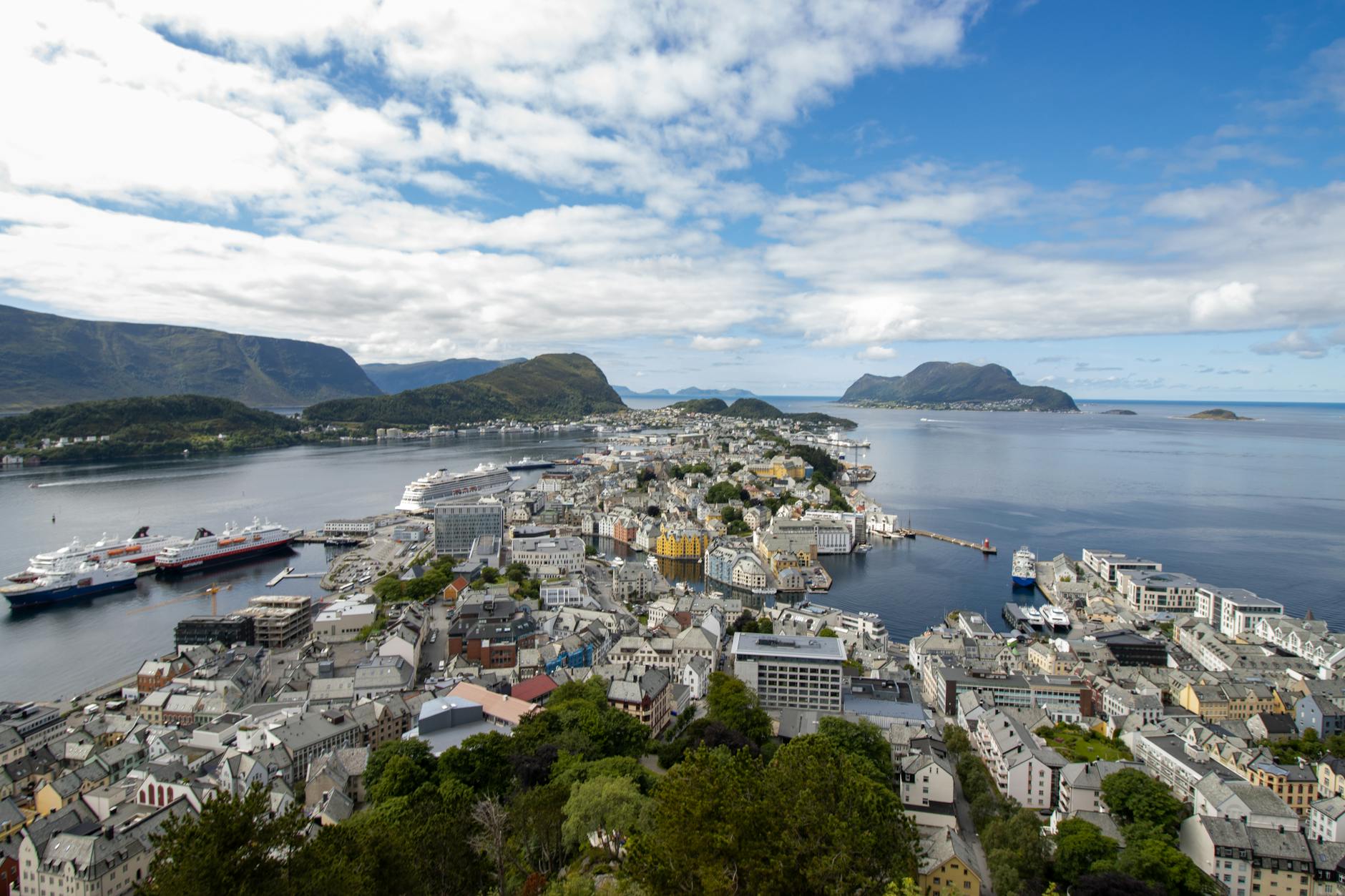
Alesund is one of the easiest cities in Norway to misunderstand because it looks so complete from a distance.
Start Here
The setting is almost suspiciously persuasive. Islands, channels, bright water, steep roofs, mountains in the distance, and an urban core rebuilt in a concentrated Art Nouveau style after the 1904 fire. The whole place seems to arrive with its own conclusion already attached: beautiful, distinctive, easy, and probably best treated as a short scenic stop before the bigger fjord drama begins.
That is the weak version of the city.
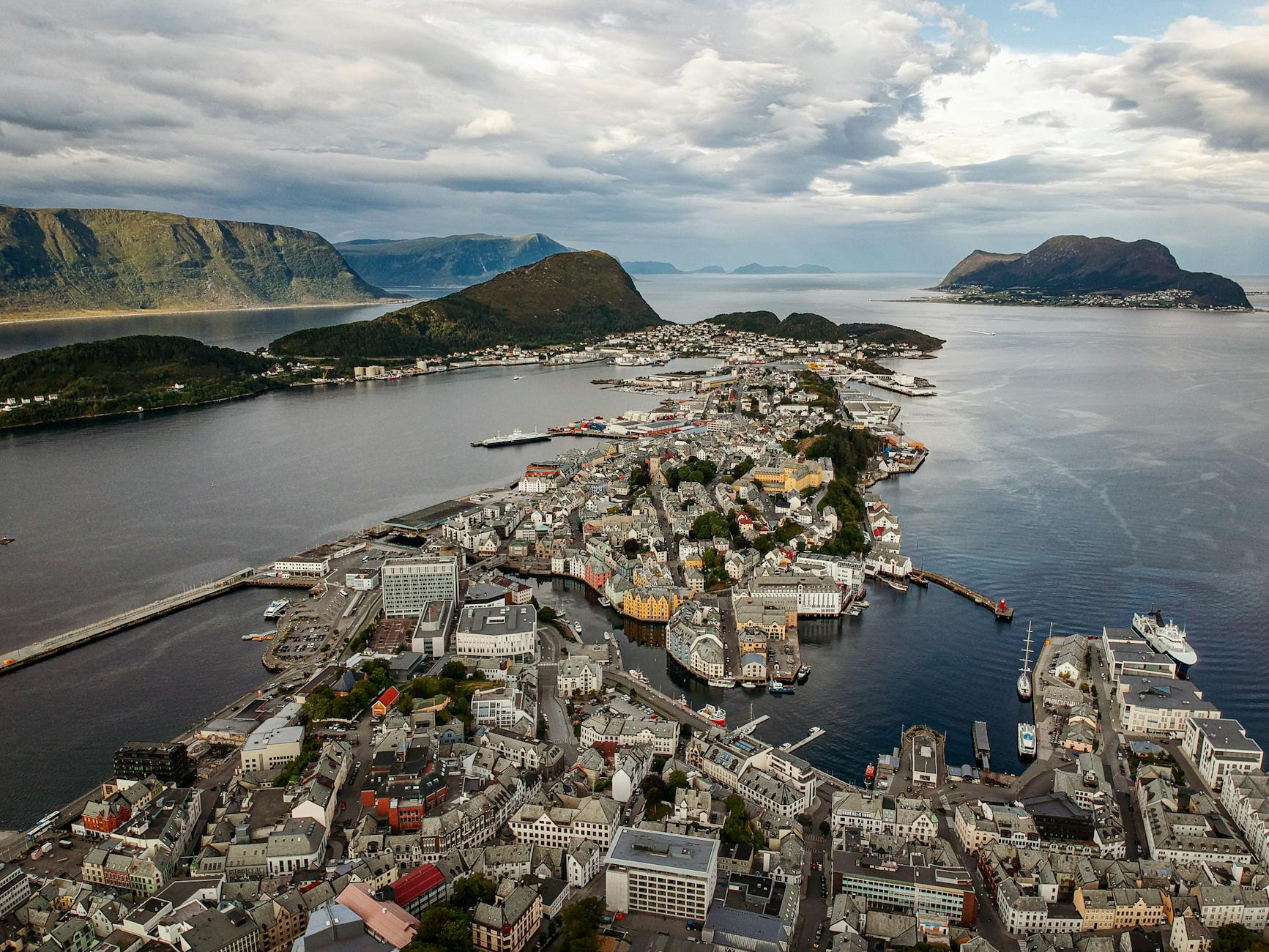
The stronger version starts by refusing to use Alesund as a pause. This is not only a viewpoint town or a transfer hub for western Norway. It is a harbor city with a specific architectural identity, a compact but real urban core, a maritime economy, and a geography that keeps land, weather, and water in active conversation. Its pleasures are not grand in scale. They are exact in scale. A good Alesund stay is built from looking carefully, walking slowly, choosing the right hotel, and understanding when the city should be the point instead of the prelude.
That matters because Alesund can flatten quickly if the visitor never moves beyond admiration. People arrive, photograph the facades, go up to Aksla, eat a decent dinner, and tell themselves they have "done" the place. Sometimes that is enough for a night. It is not enough to understand why the city feels different from so many other Scandinavian stops. Alesund is more than photogenic rebuilding. It is a place where the water routes, the Brosundet canal, the fish-and-shipping inheritance, and the whole compressed town center produce a rare kind of small-city coherence.
The city is also helped by its limits. Alesund is not trying to overwhelm you with endless neighborhoods, giant museum complexes, or a metropolitan schedule. It wins through concentration. The architecture has a thesis. The harbor has a thesis. The viewpoint has a purpose. The aquarium has a place in the city’s marine logic. Even the surrounding weather often sharpens rather than weakens the experience. Gray light and sea air do not cancel Alesund. They often complete it.
This is why hotel choice, weather discipline, and daily structure matter here more than some travelers expect. Alesund looks effortless but behaves best when handled deliberately. The city should not be rushed through on the way to "real Norway." It is already a precise version of real Norway: maritime, compact, weather-shaped, and quietly self-possessed.
The city in one sentence: Alesund is a compact harbor city of islands, water, and post-fire Art Nouveau architecture whose best first trip comes from using the town itself carefully instead of treating it as a scenic bridge to somewhere else.
Basic data
| Population | About 58,000 in the municipality |
|---|---|
| Area | 99 km2 |
| Major religions | Christian heritage with a strongly secular contemporary public culture |
| Political system | Municipality inside a parliamentary constitutional monarchy |
| Economic system | High-income mixed economy led by maritime industries, fisheries, tourism, and services |
Quick Verdict
Best for: couples, solo travelers, first-time Norway trips, architecture travelers, photographers, shorter western Norway routes, and anyone who likes smaller cities with a strong physical identity.
Not ideal for: travelers who want nonstop big-city cultural density, people who need many distinct neighborhoods to stay interested, or anyone who plans to use Alesund only as a sleep-and-leave logistics point.
Ideal first visit: 2 full days.
Minimum worthwhile stay: 1 night and 1 full day, though 2 nights is much better.
Best overall months: May, June, September, and the clearer parts of early October.
Best summer case: if you want long light, harbor walking, good viewpoint conditions, and an easy platform for mixing town time with short excursions.
Biggest planning mistake: treating the city as a photo stop between airport arrival and a fjord departure.
One thing to prioritize: your base. In Alesund, staying in or immediately beside the central harbor core changes the whole trip.
One thing to leave flexible: Aksla timing. The view is strong, but the city reads very differently in different light and weather.
The blunt version: Alesund is one of Norway's best short urban stays if you let the harbor and architecture carry real weight. If you do not, it collapses into a pretty interruption.
Who Will Love Alesund?
Alesund works especially well for travelers who like cities that are visually specific from the first hour but still reward closer reading. The architecture matters here. The city’s rebuilding after the 1904 fire gave it an unusually coherent urban face, and that coherence is one of the main reasons to come. But it is not only about ornament or style. It is about the way style, topography, and harbor life reinforce one another.
Couples tend to do well here because Alesund offers an unusually efficient kind of atmosphere. The city is small enough that the trip stays light, but strong enough that it does not feel insubstantial. A harbor walk, one excellent viewpoint, one marine or historical anchor, and a serious dinner can produce a complete day without the exhaustion that some larger destinations require.
Solo travelers also do well because Alesund is compact without being empty. The central walk is easy to understand, the setting keeps changing around you, and there is enough purpose to wandering that the city rarely feels like it runs out after an hour. Small cities can sometimes expose solitude too sharply. Alesund usually does not.
Travelers with an interest in architecture will predictably find a lot to enjoy, but the city is also rewarding for anyone who likes maritime places. Alesund still feels like a town that belongs to the water. You see it in the scale of the harbor, in the layout of the center, in the marine institutions, and in the way the whole place seems oriented outward rather than inland.
The city is less ideal for travelers whose main interest in Norway is maximum mountain or fjord intensity every waking minute. Alesund does connect well to larger landscape experiences, but the best reason to be here is the town itself.
Alesund at a Glance
| Question | Practical Answer |
|---|---|
| Main airport | Alesund Airport, Vigra |
| Best public airport move | Airport bus into central Alesund and Moa |
| Best first-time base | Central harbor core near Brosundet or the inner waterfront |
| Signature city move | Aksla viewpoint above the town |
| Signature built identity | Post-1904 Art Nouveau rebuilding |
| Signature marine anchor | Atlanterhavsparken aquarium |
| Best easy history anchor | Aalesunds Museum or a guided architectural walk |
| Car needed? | No, not for a normal first stay |
| Main public transport operator | FRAM |
| Emergency number | 112 |
| Tap water | Safe to drink |
| Currency | Norwegian krone |
| Power plugs | Type C and F |
2026 Visitor Notes
The Airport Connection Is Real, Which Helps Short Stays
Avinor’s current airport information confirms that there is an airport bus between Vigra and Alesund city center as well as Moa for major arrivals and departures.[1] That matters because Alesund is exactly the kind of small city where a clean public arrival improves the whole tone of the stay.
FRAM Makes City Movement Simple Enough
FRAM’s official bus pages and ticket-purchase guidance are straightforward: use the planner or line maps for Alesund, and buy tickets in the app, online, at traffic terminals, or on board.[3][4] Most first-time visitors will not need complicated transit strategy, only a simple understanding of whether they are moving inside town or out to a specific coastal point.
Aksla Is A Real Urban Tool, Not Just A Photo Reward
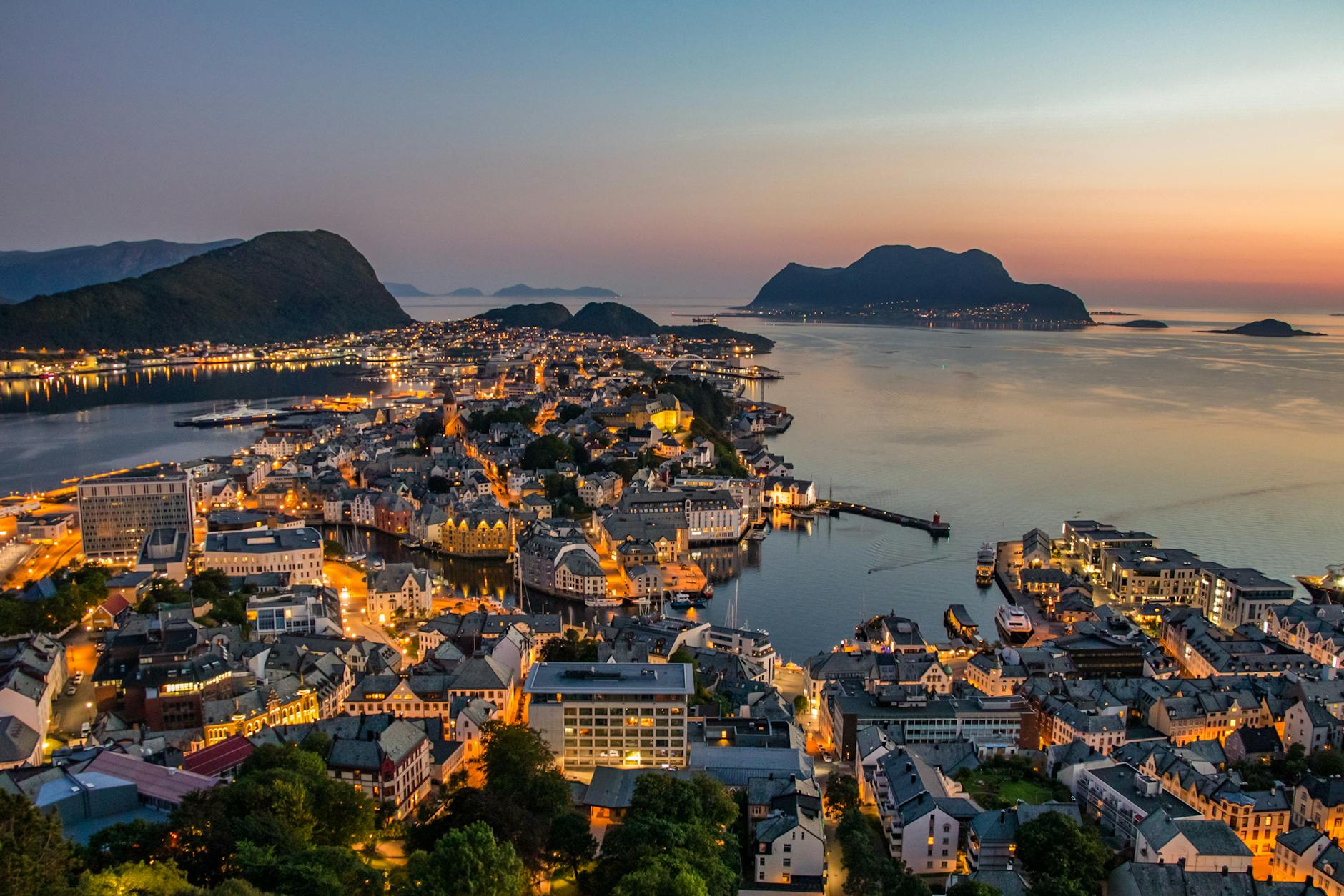
Visit Norway’s current Aksla page still emphasizes the 418 steps from Byparken and the panoramic logic of the viewpoint.[7] The point is not merely that the view is good. It is that Aksla helps you understand the city’s island structure and harbor orientation all at once.
Alesund's Art Nouveau Identity Is Still The Main Difference
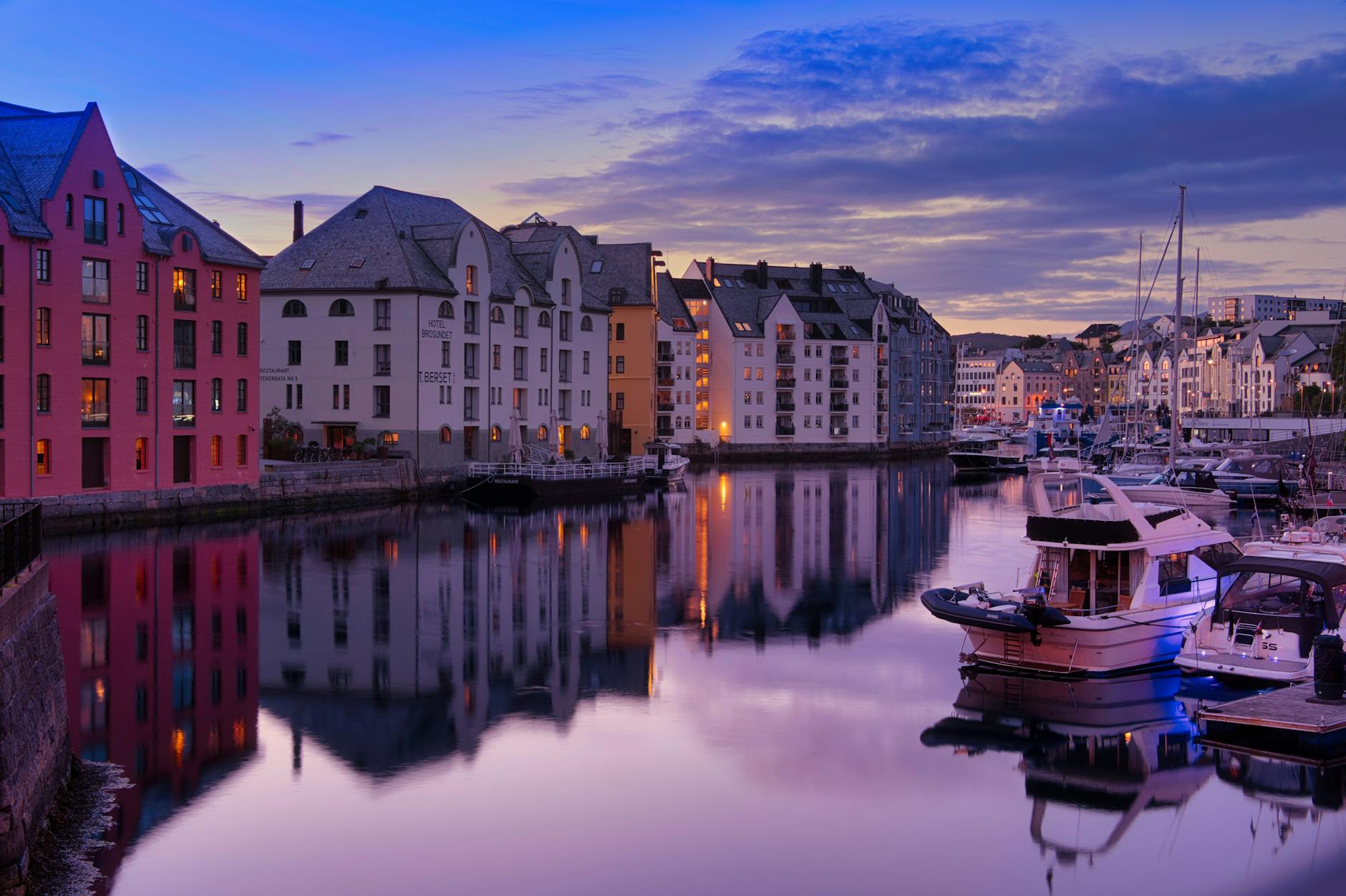
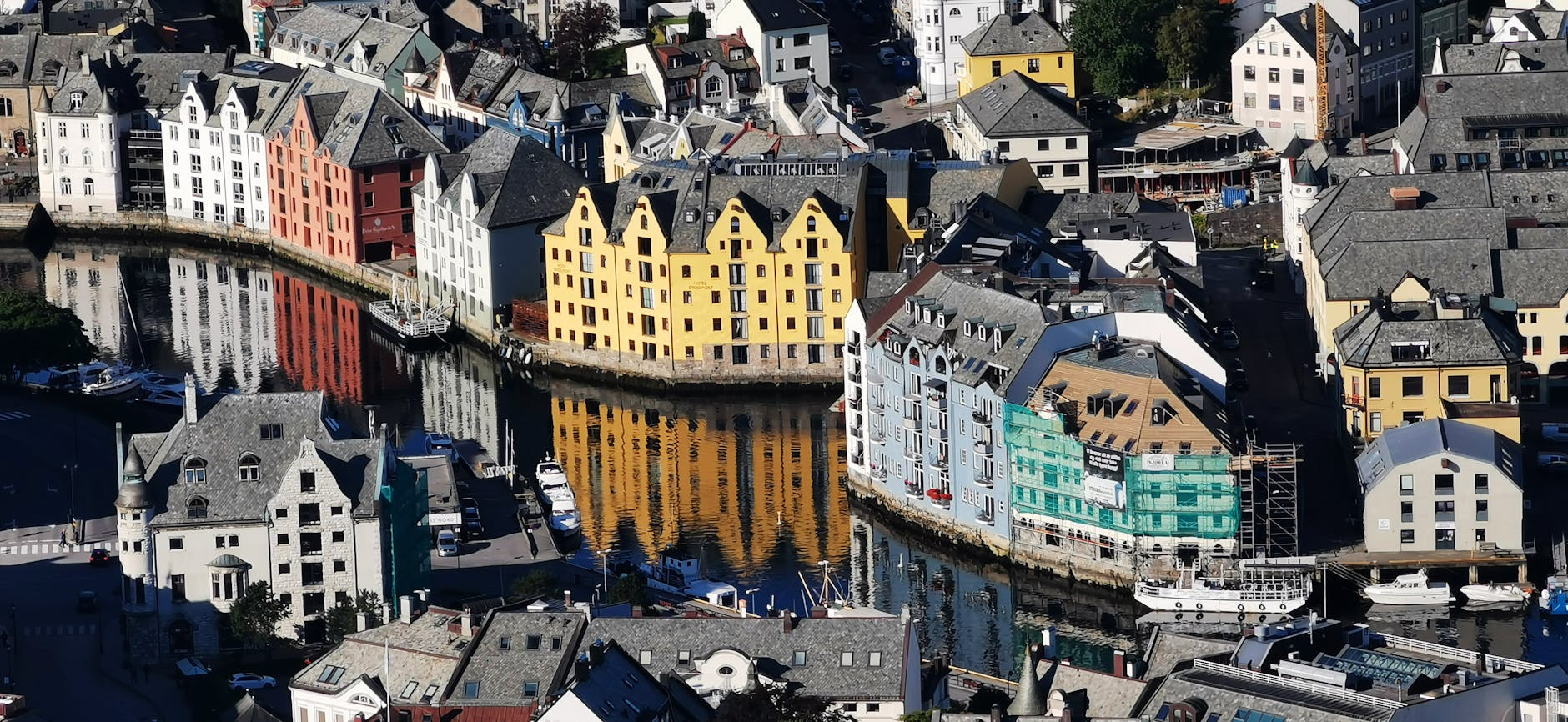
Visit Norway’s Alesund and Sunnmore pages continue to present the city’s post-fire Art Nouveau character as its defining built trait, and that is correct.[5][6] This is what prevents Alesund from becoming just another pretty Norwegian waterside town.
The Aquarium Makes Sense Here
Atlanterhavsparken’s own material describes it as one of Northern Europe’s largest saltwater aquariums and places it only 3 kilometers from the city center at Tueneset.[8] That is useful because it means the marine side of the trip can stay connected to the city rather than becoming a remote excursion.
Alesund Should Not Be Reduced To A Gateway
Official tourism material inevitably markets Alesund as a launch point for wider Sunnmore and fjord travel.[6] That is true. It is also the main threat to using the city well. The right move is to let the regional opportunity exist without letting it erase the town.
How to Understand Alesund
Alesund works through five forces.
The first is rebuilding. The 1904 fire and the city’s reconstruction are not background trivia. They explain why the city feels unusually coherent.
The second is water. Channels, harbor edges, and the island setting are not scenic extras. They shape how the city is read and used.
The third is scale. Alesund is small enough to feel manageable and large enough to feel complete, which is rarer than it sounds.
The fourth is elevation. Aksla changes the relationship between viewer and city. Without it, the town can seem flatter both visually and conceptually.
The fifth is maritime inheritance. Fishing, shipping, and ocean orientation are part of the city’s identity, not decorative civic memory.
The Five Alesunds A Visitor Actually Meets
Harbor Alesund: Brosundet, water movement, quays, and the core civic image of the city.
Architectural Alesund: turrets, facades, ornament, the post-fire rebuild, and the city’s most distinctive visual argument.
Viewpoint Alesund: Aksla, steps, outlooks, and the elevated reading that explains the town’s geography.
Marine Alesund: Atlanterhavsparken, sea air, fishing history, and the feeling that this is a place facing outward.
Gateway Alesund: ferries, buses, wider Sunnmore, and all the pressure from surrounding scenery that can either enrich or flatten the city.
The Main Mental Shift
Do not ask, "What are the top things to do in Alesund?" Ask, "How should I make this harbor city feel whole before I leave it?" That question produces better hotel choices, better pacing, and better use of your limited time.
What Alesund Does Better Than People Think
Alesund is better than people think at holding a full day or two of attention. The common assumption is that the city looks wonderful and empties out quickly. In practice, it often deepens once you start moving between harbor, museum, view, and neighborhood streets.
It is also better than people think at combining architecture and landscape without either one trivializing the other. In many destinations, one of those elements wins and the other becomes supporting material. In Alesund, the built form and the setting keep enhancing each other.
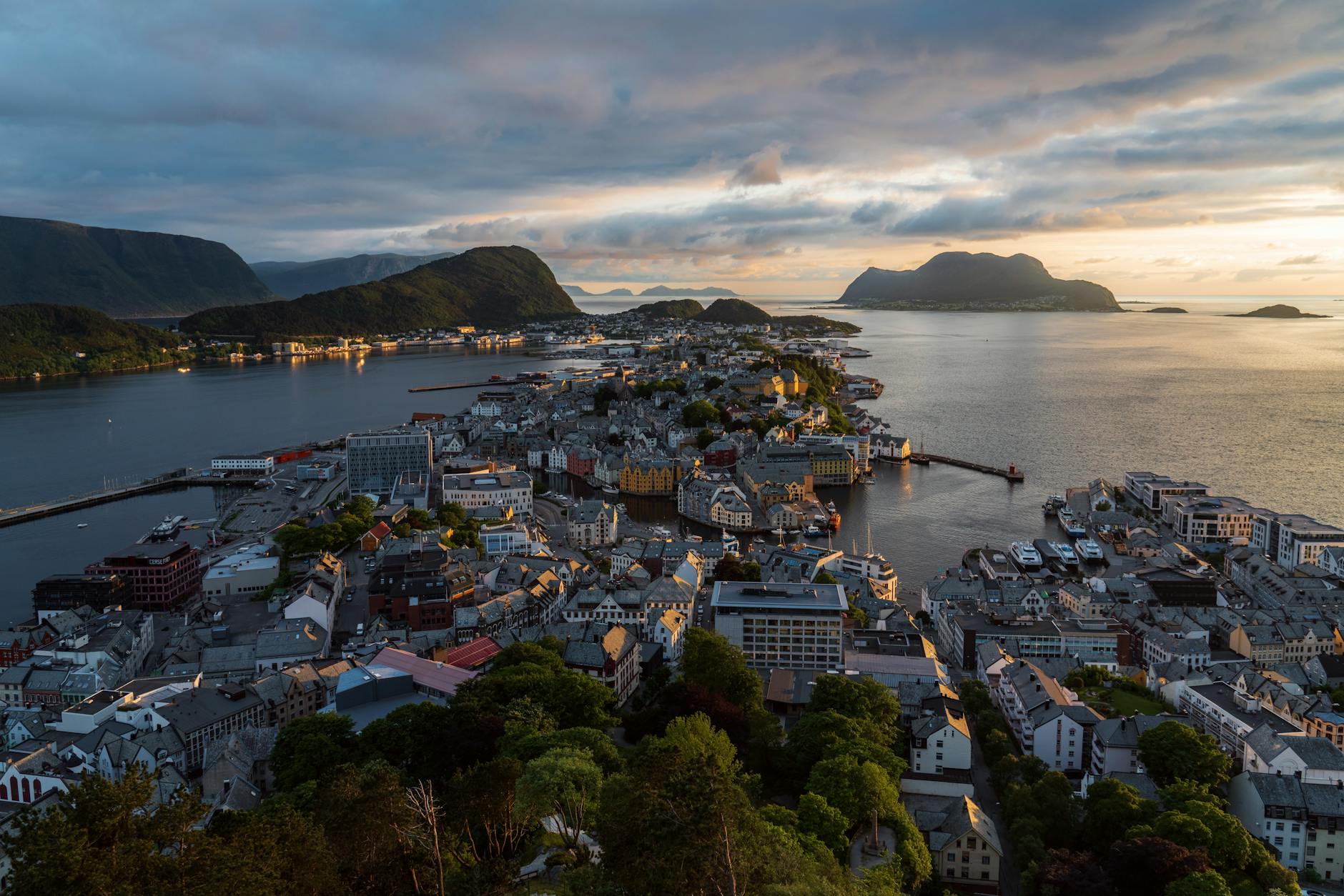
The city is stronger than some first-timers expect at weather mood. Alesund does not require sunshine to make sense. Gray light often suits it. Wind and cloud often sharpen it. This is a sea-facing town; trying to judge it only by postcard weather would miss the point.
It is also very good at short-break precision. If your Norway route has room for only one or two nights somewhere smaller, Alesund can return a lot of atmosphere for the time invested.
Finally, Alesund is better than people think at maritime seriousness. The aquarium, the harbor logic, and the fish-and-shipping memory keep the city from being only decorative.
Best Time to Visit Alesund
Alesund is usable throughout the year, but not every season offers the same version of the city.
Best Overall Months
May, June, September, and early October are the safest recommendations. These periods often give the best balance of walkability, harbor atmosphere, manageable visitor pressure, and useful daylight.
Summer
Summer is the easiest season in which to love Alesund quickly. Long light, good Aksla conditions, open water, and more reliable movement in the wider region all help. The tradeoff is that the city can feel slightly more exposed to cruise and stopover traffic.
Early Autumn
Early autumn may be the smartest choice for many travelers. The city often feels more composed, the light can be excellent, and the harbor atmosphere gains extra weight.
Winter
Winter Alesund is for people who actually want a coastal Norwegian mood, not for those hoping for a cheerful all-day sightseeing machine. The city can be beautiful, intimate, and very atmospheric, but it becomes more about weather, views when available, and interior warmth.
Spring
Spring is transitional but rewarding. The town begins opening outward again, and the city can feel especially fresh when the weather breaks in your favor.
How Many Days You Need
Half A Day
Enough to see the city, not enough to use it.
One Full Day
The minimum coherent Alesund. This gives you the center, Aksla, and either one historical or marine anchor.
Two Full Days
Ideal for most first-timers. One day should belong almost entirely to the city itself. The second can include the aquarium, slower harbor time, or a modest regional extension.
Three Days
Excellent if you want Alesund plus one more ambitious coastal or regional move without degrading the town into a transfer base.
Where to Stay in Alesund
Where you stay matters here because the city is small enough that a good location feels almost effortless and a weak location feels unnecessary.
Fast Answer
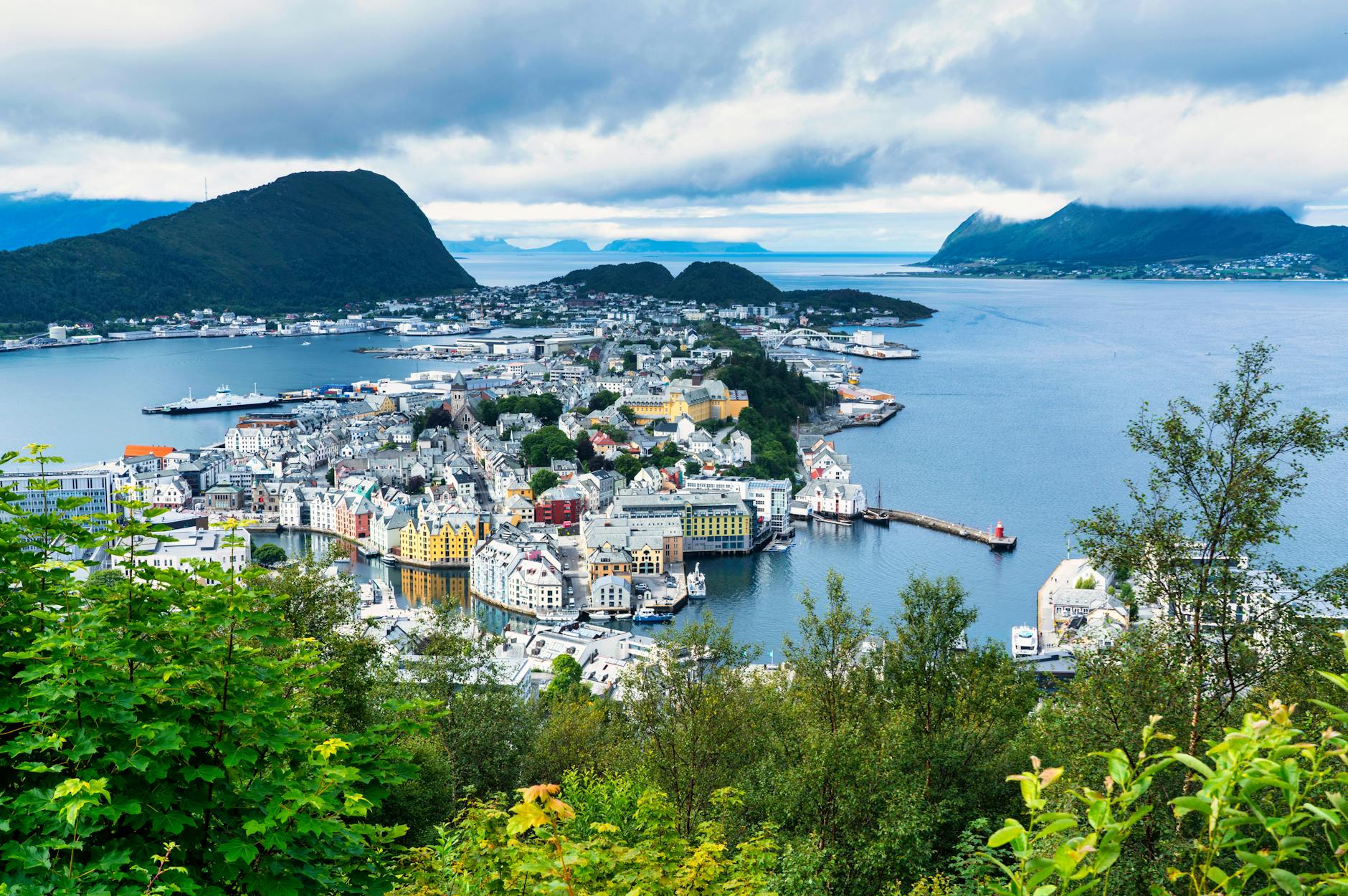
For most first-time visitors, stay in the central harbor core, around Brosundet or immediately nearby. That is where Alesund feels most itself.
Neighborhood Decision Table
| Traveler Type | Best Area |
|---|---|
| First-time visitor | Central harbor / Brosundet area |
| Couple weekend | Harbor edge or canal-facing stay |
| One-night stop done properly | Central core, no compromise |
| Car-based route | Still central, unless parking cost is your overriding concern |
| Repeat visitor | Central core or slightly quieter edge within easy walking distance |
Brosundet and the Inner Harbor
Best for: first-timers, short breaks, couples, and anyone who wants immediate atmosphere. Why it works: water, architecture, easy walking, and the city’s strongest visual identity all meet here. Tradeoff: fewer cheap options and more obvious visitor density. Best use: the default correct answer.
Central Core Beyond The Immediate Canal
Best for: travelers who want a practical base while staying fully connected to the city. Why it works: still walkable, often slightly calmer, and close to everything that matters. Tradeoff: a little less direct harbor drama out the door. Best use: efficient but still atmospheric stays.
Area Profiles
Brosundet: best for classic Alesund atmosphere and harbor identity.
Harbor core beyond Brosundet: best for slightly quieter practicality without losing the center.
Aksla-facing edge: best if you care about quick access upward more than pure waterfront position.
Neighborhood Guide: Where to Explore, Not Just Sleep
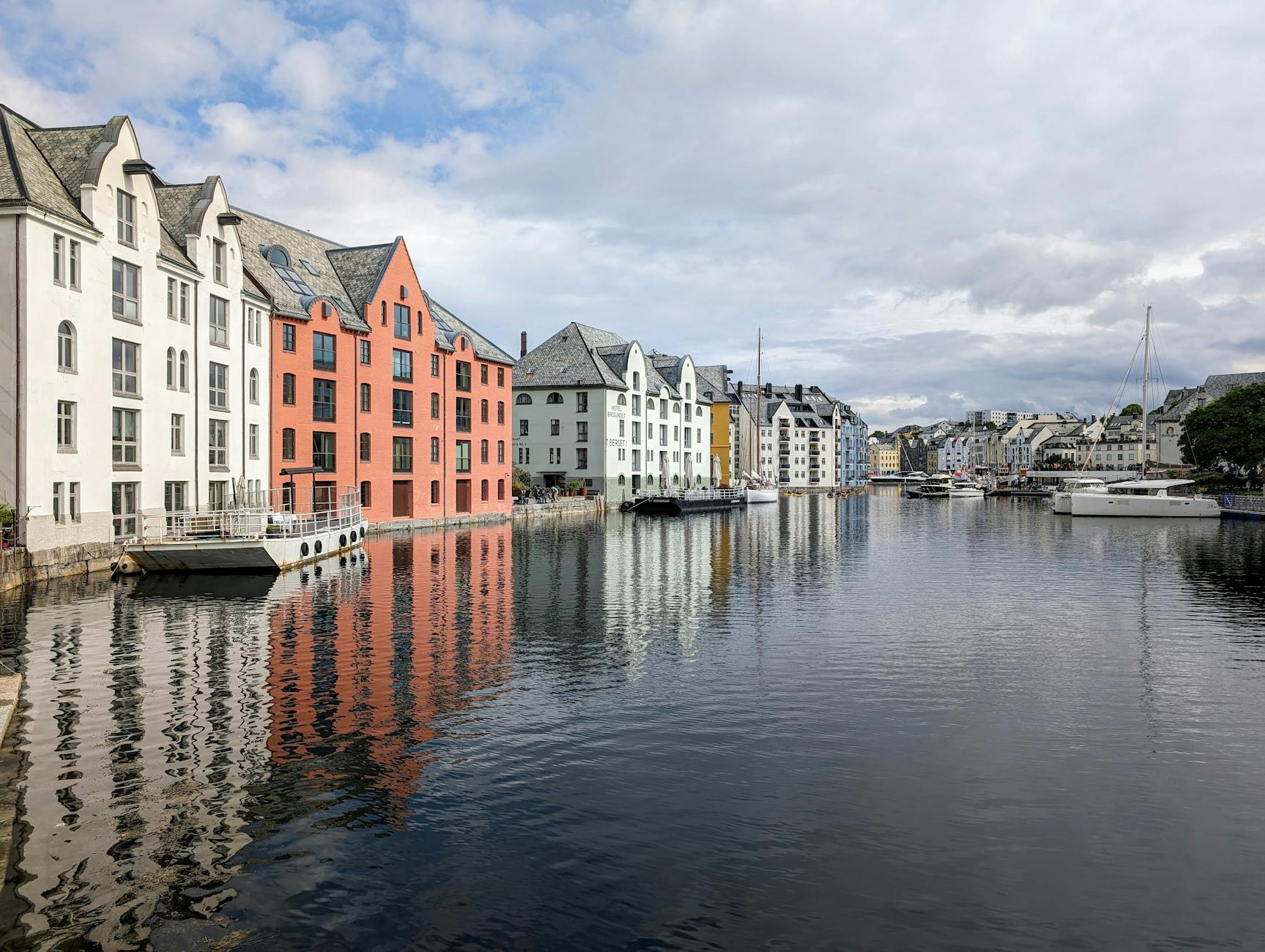
The core around Brosundet is where Alesund makes its first and strongest argument. Water, facades, boats, and rebuilt urban confidence all meet there. If you walk badly here, the city can seem like a short scenic loop. If you walk well, pausing often and taking the side streets seriously, the whole rebuild starts to feel more substantial.
The central streets away from the immediate harbor help the city feel less like an image and more like a town. This is important because some visitors stay too tightly on the most photogenic blocks and miss the broader urban texture that makes the center feel inhabited.
Aksla should be treated as an extension of the city, not as a separate attraction.[7] The climb or drive upward is part of understanding the place. The town becomes legible from above in a way it cannot from the quays alone.
Tueneset and the aquarium side reveal another Alesund, more exposed and marine-facing.[8] This is useful because it keeps the trip from staying entirely inside the aesthetic comfort of the central rebuild.
The Best Things to Do in Alesund
- Walk the central harbor and side streets slowly enough that the rebuild feels urban, not merely decorative.
- Go to Aksla in conditions that actually favor the view or the mood you want.[7]
- Use at least one museum or interpretive stop so the 1904 fire and rebuilding are not just facts you once read.
- Visit Atlanterhavsparken if you want the city’s relationship to the sea to feel more than symbolic.[8]
- Eat at least one proper seafood-centered or harbor-facing meal instead of treating food as a filler between walks.
- Let one block of time remain loose enough for the city simply to look good in changing weather.
Itineraries
If You Have One Full Day
Use the morning for the harbor core and architecture. Put Aksla in the middle of the day when light or visibility is working. Use the afternoon for one marine or historical anchor, then return to the water in the evening.
If You Have Two Full Days
This is the best first-time pattern. Keep one day almost entirely urban. Use the second for Atlanterhavsparken, a longer museum block, or a modest surrounding-islands extension while keeping dinner and the evening back in town.
If You Have Three Days
Add one more ambitious regional move only after you have already let Alesund feel complete. The city should anchor the route, not just launch it.
Itineraries By Traveler Type
For Couples
Stay on or just off the harbor, choose one excellent dinner, and let the city’s light and water do most of the work. Alesund is strongest when not overscheduled.
For Solo Travelers
Walk more than you think you need to, but cluster your day properly. The city rewards repetition and angle changes more than aggressive list completion.
For Architecture Travelers
Give the rebuilding story enough interpretive support that the facades stop being only pretty and start feeling historically specific.
For Norway First-Timers
Do not apologize for spending real time here. Alesund is not merely the appetizer before western Norway begins. It is already one of the most distinct urban forms in the region.
Food and Drink
Alesund is not a giant restaurant city, and that is part of the point. The goal here is not to build the whole trip around reservations. It is to let food reinforce the harbor logic of the stay. Seafood obviously matters, but more broadly the city wants you to eat in a way that acknowledges where you are: by the water, in a maritime town, in a place whose strongest mood often arrives in the evening.
The mistake would be to treat dinner as generic Scandinavian hotel-adjacent logistics. Alesund improves when you make one meal count, especially one that keeps a visual or atmospheric connection to the harbor. Lunch can stay lighter. Coffee can stay opportunistic. But at least one dinner should feel tied to place.
Getting Around
Alesund is primarily a walking city for a normal first stay. The center is compact, and the main challenge is not distance but discipline. Walk well and the city feels exact. Walk lazily and it can feel repetitive.
FRAM matters when you are coming from the airport, moving to Moa, or handling a specific outer route.[3][4] Taxis are perfectly reasonable if weather turns or luggage timing matters, and Avinor’s airport guidance still places taxi time to the city center at roughly 15 to 20 minutes.[2]
The practical rule is simple: walk within the center, use transport only when changing versions of the trip.
What To Skip
Skip the instinct to call Alesund "done" after one fast harbor circuit and the viewpoint. Skip sleeping in a purely practical outer location if the whole point is to experience the town. Skip letting a regional excursion consume all of a short stay. Skip comparing every hour to Geiranger, Trollstigen, or some larger scenic legend. The city needs to be judged as a city.
Common Mistakes
- Treating Alesund as a transfer point with better facades.
- Choosing a weak hotel location in a city where location is the easiest win.
- Going to Aksla at the wrong moment and assuming the viewpoint itself was the problem.
- Admiring the architecture without learning enough about the rebuilding to understand why it matters.
- Using the wider region so aggressively that the town never gets to become memorable.
My Blunt Advice
Use Alesund like a harbor city with architectural intelligence, not a scenic pit stop. Stay central. Walk the water more than once. Go above the city, not just through it. Let one museum or interpretive layer explain the rebuilt town. Let one marine stop explain why the sea still matters. Keep one evening mostly free so the light, the canal, and the facades can do what they are good at doing.
If you do that, Alesund stops feeling like a lovely interruption and starts feeling like one of Norway’s most exact small-city experiences: elegant without softness, scenic without self-indulgence, and small enough that the whole place can fit in your head by the end of the trip.
That is the right first Alesund. Not coverage. Use.
Where Alesund Fits in a Norway Trip
Alesund matters in a Norway itinerary because it gives you something that many fjord-and-scenery routes do not: a real urban chapter with maritime identity. Much of western Norway is organized around movement through landscapes, ferries, roads, and viewpoints. Alesund gives you a place where that wider coastal logic condenses into a city.
That makes it particularly valuable when a trip risks becoming only scenic transit. If every stop is an overlook, a lodge, a ferry crossing, or a village that exists mainly as access to something else, the journey can start feeling oddly thin despite all the beauty. Alesund corrects that. It offers architecture, harbor logic, weather mood, dinners that belong to a town, and one of the clearest small-city identities in the country.
It is also useful as a rebalancing stop before or after more intense nature routing. The city can restore human scale without becoming generic. Alesund is compact enough not to slow the broader route too much and strong enough not to disappear inside it.
This is why it should be treated as more than a gateway. The region around it is unquestionably important, but the city itself is one of the main reasons to come through this part of Norway in the first place.
Alesund Versus Bergen
Travelers often do not say this comparison aloud, but it shapes expectations. Both cities are western Norwegian, water-facing, and associated with timber, trade, and dramatic setting. But they do very different work in an itinerary.
Bergen is larger, denser, and more obviously city-like in the metropolitan sense. It has more neighborhoods, more institutional variety, and more urban momentum independent of scenery. Alesund is smaller, tighter, and more concentrated around a single highly coherent architectural and harbor identity.
That difference matters because Alesund should not be judged by whether it can provide Bergen’s breadth. Its strength is precision. Bergen expands outward. Alesund resolves inward. Bergen gives you a bigger field of urban options. Alesund gives you one of Norway’s clearest examples of a small city whose setting, rebuilding story, and maritime orientation all align.
Travelers who want one fuller city in western Norway may still prefer Bergen. Travelers who want a shorter, more distilled city stay that still feels distinctly coastal and Norwegian often end up surprised by how strongly Alesund lands.
First-Time Visitors Versus Repeat Visitors
Alesund is visually kind to first-timers. The first impression is already strong. You see water, towers, facades, and hills, and the city seems to explain itself immediately. This is both an advantage and a trap.
The advantage is that a short stay can feel rewarding very fast. The trap is that first-time visitors sometimes stop at the image. They assume the harbor loop, Aksla, and one meal have essentially delivered the whole place.
Repeat visitors usually understand that Alesund is better when the image becomes a route rather than a conclusion. They use the harbor more than once, pay more attention to the side streets, time Aksla more carefully, and understand that the city’s marine logic and weather mood are part of its identity rather than incidental backdrop.
This means the best first-time traveler should borrow a repeat-visitor instinct: do not let the first good view end the inquiry. Let it start the stay.
Cooler-Season Alesund Versus Summer Alesund
Summer makes Alesund easy to love quickly. The light stretches, the harbor is more active, the water reads clearly, and the city’s rebuilt Art Nouveau face seems almost too perfectly set inside its island geography. This is the season when first impressions are most flattering.
But cooler-season Alesund often clarifies what kind of place it really is. Gray skies, marine air, and shifting weather remove the temptation to treat the city like a postcard and make it read more strongly as a working harbor town shaped by the sea. The architecture can even become more interesting in less flattering light because you stop seeing only charm and start seeing character.
Autumn is especially strong for this reason. The city can feel sharper, more inward, and more exact. Winter is more conditional, of course, but for travelers who genuinely like coastal Nordic atmosphere, Alesund can still work beautifully. It simply asks for a different kind of trip: more interior warmth, more weather awareness, and less dependence on the open-water fantasy.
Shoulder season remains the easiest recommendation because it preserves both usability and atmosphere. But Alesund should not be mistaken for a fair-weather success only.
Why One Proper Alesund Day Matters
Alesund is the kind of place people often think they can “do” in a partial day. Because the center is small and the setting is visually explicit, travelers assume that a scenic circuit plus the viewpoint equals understanding. It usually does not.
One proper city day matters because Alesund’s meaning lies in the relationships between its parts. The harbor needs time to become more than a backdrop. Aksla needs to explain the island structure, not just provide proof of beauty. The museum or interpretive stop needs to connect the rebuilding story to the facades you are admiring. The marine side needs to confirm that the water is functional as well as scenic.
This does not require a huge amount of time. It requires continuous attention within a single day. Once the city has that, it starts to feel whole rather than decorative.
Why the Base Matters More Than Visitors Expect
Because Alesund is small, people often assume hotel choice is almost irrelevant. In practice, it matters a lot. A central harbor-facing or near-harbor base lets the city feel atmospheric, coherent, and pleasantly rewalkable. A more remote or purely practical base can make Alesund feel like a town you are visiting rather than a town you are inhabiting.
The right base does more than shorten walks. It changes the rhythm. You can return after weather shifts. You can re-emerge for evening light. You can let dinner happen naturally rather than logistically. You can pass the harbor multiple times and let the city improve through repetition.
In a city whose strength is concentration, the base is part of the concentration. A weak hotel location dissipates one of Alesund’s easiest advantages.
Day Alesund Versus Evening Alesund
By day, Alesund is highly legible. The facades, water edges, and island structure show themselves clearly. This is when the rebuilt city makes its neatest first argument.
By evening, Alesund often becomes more emotionally persuasive. The harbor softens, the light can become more atmospheric, and the city begins to feel less like an architectural case study and more like a living coastal place. Dinner matters more. The water matters differently. Even the same streets can seem more convincing when the visual sharpness relaxes.
This is one reason one-night Alesund stays are so much stronger than simple day visits. The city benefits from being seen twice in two different tones. Without that, it can remain too perfectly scenic and not quite lived.
Why the Wider Region Should Not Own the Whole Trip
The Sunnmøre and fjord-region temptation is completely real. Roads, islands, ferries, and famous natural landscapes all pull attention outward. But that pull can flatten Alesund if you give it full authority from the start.
When every hour in town is evaluated by what dramatic landscape it is not, the city inevitably seems secondary. That is the wrong standard. Alesund should be judged by what it offers that the surrounding region does not: compact urban identity, architectural coherence, harbor life, and a marine-facing city experience with actual atmosphere after the day’s driving would otherwise be over.
The stronger logic is simple. Let Alesund become complete first. Then let the region widen the trip. Not the other way around.
Why Food Is Structural, Not Decorative
Alesund is not a place where the whole trip should revolve around restaurant prestige, but meals still matter structurally. In a smaller harbor city, one or two good dining decisions can determine whether the place feels inhabited or merely admired.
That is especially true in the evening. A harbor-facing or harbor-adjacent meal can help the city turn from photo subject into experience. A coffee stop in the right weather can restore the day. A seafood dinner can anchor the maritime identity more convincingly than another round of sightseeing.
The point is not culinary conquest. The point is that smaller cities need inhabiting moments. Alesund becomes stronger when you have eaten in it well enough to remember the town as lived rather than only seen.
Why Alesund Often Works Better Than It Sounds
Alesund can sound too neat in summary. Art Nouveau rebuild, pretty harbor, good viewpoint, nice stop before fjords. That summary is not false, but it is small.
In practice, the city often works better than it sounds because the harbor, weather, rebuild story, and marine orientation give it more depth than the summary suggests. It is still beautiful, but the beauty belongs to a real town with a real maritime inheritance. That distinction matters.
Travelers who arrive expecting only prettiness often leave with something stronger: a memory of a small city that felt exact rather than merely charming.
Why Alesund Often Improves on the Second Visit
The first visit to Alesund is usually dominated by the obvious and correct opening moves: the harbor, Aksla, the rebuilt center. Those are essential. But the second visit often becomes more personal because you stop using the city only through its postcard strengths.
You notice the weather more. You walk the side streets more patiently. You time the harbor better. You become more interested in the marine layer and less concerned with proving you saw the “best” angle. The town starts to feel less like a scenic object and more like a place with habits and mood.
Not every traveler will return, of course. But understanding that Alesund belongs to the type of city that rewards repeat attention helps first-timers travel better. It encourages them not to force instant totality.
How Alesund Changes Over the Course of a Stay
On arrival, Alesund often feels almost too resolved. The city seems to have already won the argument before you begin. Water, facades, hills, done. That is why first impressions can be deceptively final.
Then the city usually starts changing register. The rebuild story gives the beauty more weight. Aksla turns the center into geography. The harbor begins to feel less like scenery and more like structure. The marine side broadens the city’s identity beyond architecture alone.
By the second evening or second morning, Alesund often feels more complete and less fragile than it did at first glance. That is its best trick. It begins as a lovely image and ends, if used well, as a memorable small city.
Source Notes
- 1. Avinor, official Alesund Airport public transportation page: [https://www.avinor.no/en/airport/alesund/info/public-transportation/](https://www.avinor.no/en/airport/alesund/info/public-transportation/)
- 2. Avinor, official Alesund Airport taxi page: [https://www.avinor.no/en/airport/alesund/info/taxi/](https://www.avinor.no/en/airport/alesund/info/taxi/)
- 3. FRAM, official bus timetables and line maps page: [https://frammr.no/journey/timetables-and-line-maps/bus/](https://frammr.no/journey/timetables-and-line-maps/bus/)
- 4. FRAM, official how-to-buy-tickets page: [https://frammr.no/billettar/slik-kjoper-du-billett/](https://frammr.no/billettar/slik-kjoper-du-billett/)
- 5. Visit Norway, official Alesund and Sunnmore overview: [https://www.visitnorway.com/places-to-go/fjord-norway/alesund-sunnmore/](https://www.visitnorway.com/places-to-go/fjord-norway/alesund-sunnmore/)
- 6. Visit Norway, official plan-your-trip page for Alesund and Sunnmore: [https://www.visitnorway.com/places-to-go/fjord-norway/alesund-sunnmore/plan-your-trip/](https://www.visitnorway.com/places-to-go/fjord-norway/alesund-sunnmore/plan-your-trip/)
- 7. Visit Norway, official Mount Aksla page: [https://www.visitnorway.com/listings/mount-aksla-in-alesund/13893/](https://www.visitnorway.com/listings/mount-aksla-in-alesund/13893/)
- 8. Atlanterhavsparken, official about page: [https://www.atlanterhavsparken.no/om-atlanterhavsparken](https://www.atlanterhavsparken.no/om-atlanterhavsparken)